The Night Before Listing: Pre-Market Signals to Watch
Listing day preparation begins the evening before. Three signals deserve your attention:
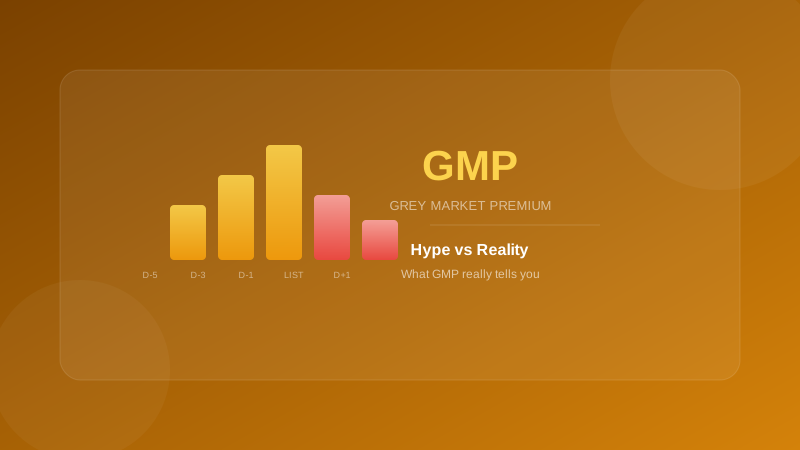
- Final GMP (Grey Market Premium) — The closing GMP on the night before listing is the grey market's last-minute consensus on where the stock will open. Track it on Ipogo.in.
- Broader market sentiment — Check Nifty 50 futures and SGX Nifty to gauge whether the broader market is opening gap-up or gap-down. Even a fundamentally strong IPO can list weak if Nifty opens 2% lower.
- Sector peer movement — Check how listed peers in the same sector traded the day before listing. A sector-wide sell-off can drag even a high-GMP IPO down on listing day.
Understanding the Opening Mechanism
IPO stocks do not open in continuous trading. They open via a pre-open call auction session from 9:00 AM to 9:45 AM on listing day. During this window:
- Buy and sell orders are collected but not matched
- The exchange algorithmically determines an equilibrium opening price that maximises traded volume
- At 9:45 AM, the stock opens at this price and enters normal continuous trading
This mechanism prevents extreme opening-bell volatility and gives all investors a fair entry/exit price at open.
The Three Listing Scenarios
Scenario 1: Strong Listing (Price > Issue Price by 20%+)
If the stock lists significantly above the issue price, you have a few choices:
- Book full profit immediately — Capture your gains. Post-listing profit-booking by allottees can push the price lower intraday.
- Book 50%, hold 50% — A balanced approach. You lock in guaranteed profit while keeping exposure if the stock continues to rally.
- Set a trailing stop-loss — Move your stop-loss up as the price rises to protect accumulated gains.
Scenario 2: Flat or Modest Listing (Issue Price ± 5%)
A flat listing often signals that the IPO was fairly priced. This is not necessarily bad news. Evaluate:
- Do the fundamentals justify a higher valuation over 6–12 months?
- Is management quality strong enough to trust for the long term?
- Is there a re-rating catalyst (new contracts, product launch, sector tailwind) on the horizon?
Flat-listing IPOs with strong fundamentals often deliver better 12-month returns than stocks that surge 80% on Day 1 and then correct sharply.
Scenario 3: Weak Listing (Price < Issue Price)
A below-issue-price listing — commonly called a "listing loss" — is every retail investor's nightmare. Options:
- Cut losses immediately — If you have no conviction in the long-term business, exit and redeploy capital. Averaging down on a bad business is a trap.
- Hold if fundamentals are intact — Sometimes good companies list poorly due to market conditions, not business quality. Re-read the RHP and make a fresh, unemotional assessment.
- Never average blindly — Don't buy more simply because the price is lower. Ask why the price is lower.
Intraday Volatility: The First 30 Minutes
The first 30 minutes after the pre-open session are typically the most volatile. Large institutional sellers (who received allotment in QIB/NII categories) often exit in this window to lock in profits. This can create a sharp initial dip even after a strong opening — the classic "sell on listing" pattern.
Patient investors sometimes use this dip to buy additional shares of high-quality IPOs at a better price than the opening.
Psychology Traps to Avoid on Listing Day
- FOMO buying at the open — Chasing a stock that has already surged 60% at open is rarely a good trade
- Anchoring to the issue price — The issue price is irrelevant to future performance. What matters is current valuation vs future earnings
- Panic selling on an intraday dip — Intraday volatility on listing day is extreme. Don't let a 5% intraday swing force a decision
- Overconfidence after a big listing gain — One big win can lead to over-sized bets on the next IPO. Risk management must survive both wins and losses.
The Long-Term Perspective
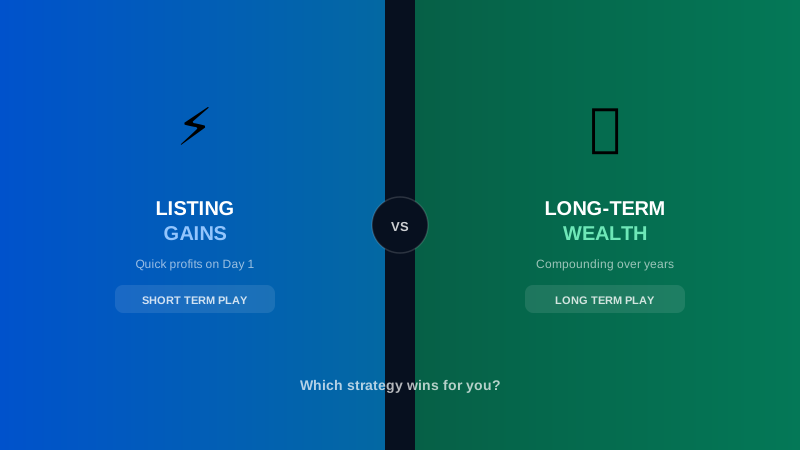
History shows that the best-performing IPO investments are often held for 2–5 years, not sold on Day 1. Companies like Zomato, Nykaa, and several PSU IPOs rewarded patient holders far more than flipper investors — after an initial period of correction. The key question is always: Is this a great business at a fair price, or a fair business at a great price?
Follow live listing prices, real-time GMP, and subscription trends on Ipogo.in to stay informed every step of the way.